6. The Law of Polarity
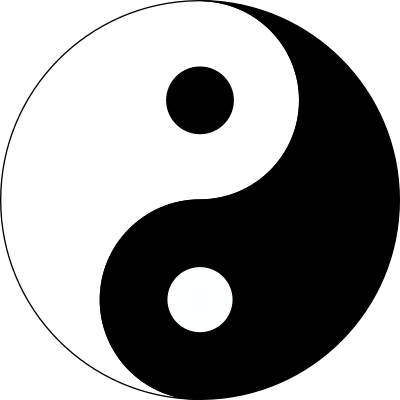
Opposites are the extremes of the whole
Everything in this world appears to have two poles – Yin (feminine) and yang (masculine), positive and negative, “yes” and “no”, light and darkness, noise and silence, peace and war etc. In everything there are opposites, but they complement each other and are the two extremes of one. The opposites are the two uttermost manifestations of the same thing, and this is the wisdom of the Law of Polarity. The opposites are a one, they are both of the same substance, but they just have different density of a vibrational level, with many varying degrees between them.
The opposites are the two manifestations of the same thing
For example, light and darkness: we see them as different, opposite things, but in fact, they are one. We assume that light is only what we perceive through our eyes. Yet, the human eye sees less than 1% of the range of rays emanating from the energy of the universe - between the red and violet electromagnetic waves. Our human eye is not able to grasp that there are many degrees and different kinds of light. We can only see what our eye can grasp. But the vibrations of the absolute light are present in a seemingly dark space. There is no such thing as complete darkness.
Same applies to positive and negative. There is something like a scale or a gradient between each pair of poles - from the starting point until the utmost developed one, with all the varying points in between them. Naturally, if these two poles are placed next to each other, the difference seems to be so big that they appear to be opposites. But they are the two opposites of the same essence. Likewise, heat and cold, black and white, noise and silence, although appearing as opposites, are actually different shades or degrees of the same thing.
The negative or the dark is not the antithesis of the positive or the light, according to the Law of Polarity. The meaning and function of the negative might also well be to serve as a driving force for change, development and evolution towards a higher end.
The Law of Polarity also applies to feelings and other mental experiences. For example, love and hate - two seemingly contrasting feelings which can sometimes pass into each other, so we have different variations of our feeling to the same person at different points in time, or sometimes, we can feel that we love and hate the person at the same time. Indeed, we are able to love and hate a person at the same time, but what is important is that we have strong emotion towards that person that changes on the range of scale up or down.
The truth is, opposite poles are a part of the one, they are of the same essence, just with different vibrational frequencies.
Here is the secret: because of this Law, it is possible to convert the opposite poles of our emotions and feelings into one another with the effort of our conscious mind. All we have to do is to move the frequency to the higher end.
This transmutation is achieved by changing the degree of the same thing. For example, fear can be consciously transformed towards courage by the effort of our conscious mind. All we have to do is to first, understand consciously how we feel. Second, acknowledge our current state: our current feeling and emotions. And lastly, raise the frequency of that feeling towards the higher end, transforming it into the desirable frequency. It does take practice and using other instruments in order to be able to achieve this transformation, so keep reading the site and you will be fully equipped.
Applying the Law of Polarity to your advantage
In order to be able to transform your emotions and raise their frequency, we need to learn how to consciously manage them.
Emotion - is a reaction to a situation.
To control it, it is fundamental to understand the nature of that emotion.
Emotions evolve as a reaction to the outer or inner irritant. But the ability to analyse, argument and judge is a skill that we develop throughout life. It is not necessary for emotions to prevail over reasoning in every situation. Managing your emotions is a skill.
In the moment of anger or resentment we tend to say hurtful or unpleasant things to people who did not really deserve it. Then we regret it but that uncontrolled reaction of ours unavoidably leads to deterioration of the relationship. Also, emotions exposed in the wrong place and time can damage or even destroy your reputation. Negative emotions damage us but you always have a choice: whether you follow their lead and distress yourself, or accept your mistake and work to amend it.
Our self esteem fully depends on our emotions. The more we keep saying: ‘all is bad’ or ‘not as we wanted’, the less satisfaction we have from life. We start feeling like loosers and it leads to depression.
Too many negative emotions leads to mental breakdown and health problems. So how do we manage our emotions and raise their frequency?
There are 4 main emotions distinguished: happiness, fear, anger and sadness.
Remember, there are no emotions we should be ashamed of. We must never divide our emotions to right and wrong because we cannot initially choose what to feel until we analyse them.
Thus, first of all, analyse your emotion. Take conscious approach to studying your emotional mood. Ask your self: How do I feel? What emotion is that? What is the reason for that emotion? Once we split out emotions to its building blocks and understand their nature, they loose their power to control us and our conscious mind begins to prevail.
Agression that we feel towards a certain situation or a person, very often does not really relate to that person, but to our past negative or painful epxerience. It is our past experience that comes out in the form of a negative emotion. That is why we must develop a skill of using consious analysis and not letting emotions to overtake us.
The main secret and excellence in controlling your negative emotions is the ability to see that between stimulus and response there is a space.
In that space between the cause and your reply you always have choice how to respond and react to a given situation. There is that time gap from the cause and your response that allows you to build your response in accordance with your values, principles and main goals in life.
The ability of not allowing your emotions to take control over you is the key tool that will lead you to success in life.